
Key Takeaways:
- ChatGPT is legal to use, but what you do with it matters. Illegal activities, sensitive data, or misuse can create real legal risks.
- Your ChatGPT chats may become relevant in a legal case. Whether they can be obtained or used depends on the facts, applicable law, and circumstances.
- ChatGPT conversations aren’t automatically protected by attorney-client privilege. Privacy and legal privilege are two different things.
- Never blindly trust ChatGPT for legal research. It can produce outdated laws, incorrect claims, or completely fabricated court cases.
- Use ChatGPT carefully with sensitive information. Avoid sharing confidential legal, personal, business, or security details, especially during active litigation.
Is ChatGPT legal to use? Yes. But that’s not really your question, is it?
Your real question is scarier. Can this thing get me in trouble?
Using ChatGPT is generally legal. That doesn’t mean everything you type into it is safe or protected. Risk shows up when you use it for something illegal, share confidential information, trust a made-up legal answer, or treat it like a private lawyer.
Whether a chat can be pulled into a legal case later depends on the facts, the law, and what you actually did.
Here’s the truth. Most people use ChatGPT and never hit a single problem. But some people paste in things they shouldn’t, like a client’s name, a court case, or a work secret, and don’t even realize what they just did.
This blog walks you through exactly when ChatGPT use is safe and when it isn’t.
Is ChatGPT Legal to Use?
Yes.
Is ChatGPT legal to use in the plain sense of opening the app, typing a question, and getting an answer? Totally fine. No law says you can’t chat with an AI tool.
The real question isn’t whether you opened ChatGPT. It’s what you did with it and what you typed into it.
| ChatGPT use | Legal concern |
| Brainstorming ideas | Very low |
| Writing or rewriting text | Very low |
| General research | Just double-check facts |
| Typing in confidential info | Privacy risk |
| Legal case strategy | Privilege risk |
| Using it to deceive someone | Real legal trouble |
See the pattern? The tool isn’t the problem. The use is.
When Can Using ChatGPT Create Legal Trouble?
Let me be blunt for a second. ChatGPT will not stop you from doing something dumb. It just answers what you ask.
So the trouble usually comes from one of these:
| Situation | Why it gets risky |
| Sharing confidential info | It leaves your hands and sits with a third party. |
| Using AI to plan something illegal | AI doesn’t make illegal things legal. |
| Giving away client details | Breaks confidentiality duties |
| Trusting made-up legal facts | Wrong info in real documents |
| Copying copyrighted text | Copyright issues |
| Hiding that content is AI-made | Some rules require disclosure. |
| Using AI during a live court case | Discovery and privilege questions |
None of these means “don’t use ChatGPT”. They mean think before you type.
Can Your ChatGPT Conversations Be Used Against You?
Here’s where people get nervous. And honestly, they should think about this a little.
Let’s be careful with the wording here, because the real answer isn’t a flat yes or no.
In some situations, AI chats or the records tied to them may become relevant if there’s a legal case. Whether they actually have to be handed over depends on the facts, the law that applies, and the situation around it.
That’s not fear-mongering. That’s just how discovery works with any digital record: emails, texts, and yes, AI chats too.
A private chat isn’t automatically a secret chat in the legal sense. Keep that one sentence in your head. It matters more than anything else in this article.
Are ChatGPT Conversations Protected by Attorney-Client Privilege?
No, not automatically. Not even close, honestly.
ChatGPT isn’t your lawyer
This sounds obvious when you say it out loud. But people forget it the moment they’re stressed and typing fast at 1 AM, venting their whole legal problem into a chat box.
ChatGPT can’t represent you. It has no licence, no bar number, and no duty to protect you.
Privacy and privilege are two different things
People mix these up constantly. Privacy is about who can see your data. Privilege is a legal protection that shields specific communications between you and your lawyer from being used in court.
A chat can feel private and still have zero privilege attached to it.
Telling a secret to a third party can waive privilege
If something was privileged and you share it outside that lawyer-client relationship, including typing it into an AI tool, you may weaken or lose that protection. This is called waiver, and it’s a real legal concept, not a scare tactic.
Your lawyer’s involvement changes things
| Situation | General concern |
| Asking ChatGPT for general legal info | Not privileged automatically |
| Typing confidential case facts into ChatGPT | Confidentiality and discovery risk |
| Asking your actual lawyer for advice | Attorney-client privilege may apply |
| Using AI under your lawyer’s direction | Depends on the tool, facts, and law |
Privilege is fact-specific and jurisdiction-specific. Using AI doesn’t automatically kill your legal protections, and it doesn’t automatically create them either.
What the 2026 Heppner Case Teaches Us About AI and Legal Privilege
This is the case everyone in the legal world has been talking about this year. So let’s actually dig into it, instead of just name-dropping it as most articles do.
What happened?
Bradley Heppner was facing federal fraud charges. Before his arrest, he used the AI tool Claude on his own, with no lawyer involved, to write reports about his defence strategy and what he might argue about the facts and the law. Later, his lawyer got involved, and Heppner argued these “AI documents” were privileged.
The government disagreed and asked the court to force him to hand them over.
On February 10, 2026, Judge Jed S. Rakoff of the U.S. District Court for the Southern District of New York sided with the government. He followed up with a full written opinion on February 17, 2026, explaining his reasoning in United States v. Heppner.
Why the court rejected protection
Three reasons, and honestly, they’re pretty logical once you see them laid out.
- Claude isn’t an attorney. So the communication never met the basic requirement of being between a client and a lawyer.
- The chats weren’t confidential in the legal sense; the AI provider’s own policy allowed data use and disclosure in certain cases.
- Heppner acted on his own, not under his lawyer’s direction. Work-product protection generally needs that direction from counsel.
What Heppner does NOT mean
Here’s the part almost nobody explains properly, and it’s honestly the most important bit.
Heppner does not mean every AI-assisted document is automatically discoverable or unprotected, full stop. The outcome depended heavily on who used the tool, why, and whether a lawyer was directing the work. A defendant chatting alone with a consumer AI app is a very different scenario than a law firm using a controlled AI system under attorney supervision.
Later commentary and reporting on AI-assisted legal work has shown courts taking different approaches depending on these exact details. So treat Heppner as a warning sign, not a universal rule carved in stone.
Can AI-Assisted Work Ever Receive Legal Protection?
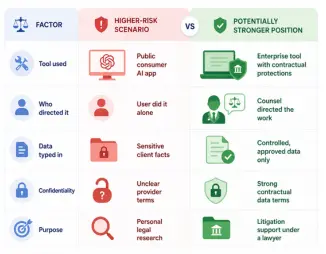
Don’t panic and close this tab yet. There’s a more balanced picture here.
| Factor | Higher-risk scenario | Potentially stronger position |
| Tool used | Public consumer AI app | Enterprise tool with contractual protections |
| Who directed it | User did it alone | Counsel directed the work |
| Data typed in | Sensitive client facts | Controlled, approved data only |
| Confidentiality | Unclear provider terms | Strong contractual data terms |
| Purpose | Personal legal research | Litigation support under a lawyer |
One thing I want to clear up right away is that using a business or enterprise AI plan doesn’t magically create attorney-client privilege. It’s a data-handling protection, not a legal privilege. Two different things wearing similar-looking clothes.
What Information Should You Think Twice About Entering Into ChatGPT?
Here’s a simple checklist. If it’s on this list, pause before you hit enter.
Personal information
- Full name and address
- Financial account details
- ID numbers or documents
Legal information
- Case strategy or arguments
- Lawyer conversations
- Witness names or evidence details
- Settlement talk
Business information
- Trade secrets
- Customer records
- Internal financial numbers
- Confidential contracts
Security information
- Passwords
- API keys
- Login credentials
Before sharing personal or sensitive information with an AI tool, it also helps to understand the common mistakes people make when using ChatGPT, especially when convenience starts replacing basic privacy judgment.
ChatGPT Privacy Settings: What They Actually Change
People love saying, “I’ll just turn history off; problem solved.” I get why. It feels like a fix.
It isn’t, not fully.
Let’s break down what these settings really do, based on OpenAI’s own documentation.
- Turning off “Improve the model for everyone” stops your chats from training the model. They still show up in your chat history, though. This setting can be changed anytime, and it applies across your whole account, web and mobile.
- Temporary Chat doesn’t save to your history, doesn’t build memory, and isn’t used for training. These chats get deleted from OpenAI’s systems after 30 days.
- Business accounts, ChatGPT Team, Enterprise, and the API don’t train on your inputs or outputs by default. Consumer ChatGPT works differently unless you opt out yourself.
Here’s the sentence I’d bold if I could reach through the screen and highlight it for you:
Turning off model training is not the same as making a conversation legally privileged.
One changes how a company uses your data. The other is a legal shield. Don’t confuse the two. I’ve seen people assume privacy settings equal legal safety, and that’s just not how it works.
For the full list of OpenAI’s legal terms and privacy documents, you can check their Terms & Policies page.
Can ChatGPT Give You Legally Reliable Answers?
Now let’s talk about a different kind of risk. Not privacy. Accuracy.
ChatGPT can get things wrong. Confidently wrong, which is worse than obviously wrong.
It can:
- Mix up which state’s or country’s law applies
- Quote an old law that’s already been changed
- Misread what a rule actually says
- Make up a court case that never existed
- Sound completely sure while being completely incorrect
That last one trips people up the most. It doesn’t hedge the way a nervous intern would. It just states things like facts.
This is one reason understanding AI hallucinations matters before you use ChatGPT for anything touching laws, contracts, court steps, or regulations.
Why You Should Never Rely on ChatGPT Alone for Legal Research
Simple rules here. Follow them.
- Verify every case name it gives you.
- Verify every law or statute it mentions.
- Check which jurisdiction the rule actually applies to.
- Confirm the law is still current, not outdated.
- Talk to a real, qualified lawyer for anything serious.
Studies looking at AI-generated legal citations have found real problems with made-up or inaccurate case references. That’s not a reason to avoid ChatGPT entirely. It’s a reason to treat it like a rough draft, not a final answer.
How People Use ChatGPT Legally And Where the Risk Changes
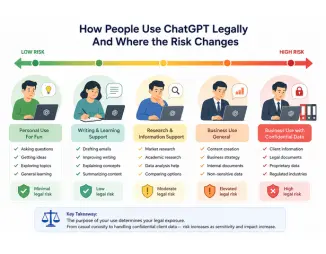
Most ChatGPT use is boring, honestly. Brainstorming. Writing help. Learning a new topic. Summarizing an article. None of that carries much legal weight.
But the risk level shifts as the purpose shifts. Personal use for fun sits at one end. Business use with confidential client data sits way over on the other end.
If you’re curious about the wider ways people use the tool, our guide on how people use ChatGPT covers the common use cases. Here, the real question is different: how does the purpose of your use change your legal exposure?
What About AI-Generated Content?
Different angle now. Not privacy. Not accuracy. Ownership and disclosure.
Things to think about:
- Does the content copy someone else’s copyrighted work too closely?
- Do you need to disclose that AI helped write it? Some workplaces and platforms require this.
- Are you claiming it’s 100% human work when it isn’t?
- Did you actually review it, or just copy-paste and publish?
For readers using ChatGPT to write articles, marketing copy, or anything publishable, our guide to AI content creation covers the full workflow. The legal question here is narrower: does the finished content follow the rules that apply to where it’s being used?
Using ChatGPT for Business? Your Legal Risk Can Be Different
Business use raises the stakes. There’s more at play: customer trust, employee data, contracts, and trade secrets.
A few things worth knowing:
- Company policy usually decides which AI tools are even allowed
- Customer and employee data deserves extra caution
- Trade secrets typed into a public AI tool can lose some legal protection
- Approved, contract-covered enterprise tools carry different terms than the free consumer app
If you’re using ChatGPT to speed up work tasks, you can also check out useful ChatGPT prompts for business tasks, but business prompts should never become an excuse to paste confidential company or customer info into a tool your employer hasn’t approved.
7 Rules for Using ChatGPT More Safely
Save this list. Actually save it.
- Don’t type anything you wouldn’t want exposed publicly.
- Strip out names, IDs, and other personal identifiers where you can.
- Don’t treat ChatGPT like your lawyer. It isn’t one.
- Double-check any legal claim it gives you.
- Follow your employer’s AI rules, if they have any.
- Use privacy settings and temporary chat when it fits.
- If you’re in active litigation, ask your attorney before using AI for anything case-related.
What If You’ve Already Shared Sensitive Information With ChatGPT?
Take a breath. Seriously. This happens more than you’d think, and panicking doesn’t help.
Here’s what to actually do:
- Don’t panic: one chat rarely changes everything overnight.
- Don’t assume it’s automatically going to be used against you.
- Don’t assume it’s automatically protected either.
- If it connects to an active legal case, tell your lawyer right away.
- Ask your lawyer about any preservation duties you might have.
- Go check the platform’s current privacy and data settings.
- Stop adding more sensitive info until you understand the risk you’re already carrying.
That’s it. No dramatic fix. Just steady, sensible steps.
My Take: ChatGPT Isn’t the Problem; Using It Without Understanding the Risk Is
Here’s where I think most people get this wrong.
The problem was never really ChatGPT. The problem is how easy it makes oversharing feel. You type a question, it answers back like a real conversation, and something about that back-and-forth lowers your guard. It feels like talking to a person you trust, when really it’s a product with data policies attached.
One mistake I’ve learned not to make trusting an AI answer just because it sounded confident. Confidence and correctness aren’t the same thing, especially with legal information.
If I had to boil down one rule for myself, it’d be this: before typing something sensitive, ask whether I’d be okay explaining, out loud, why I put that information into an AI tool. If the answer feels uncomfortable, that’s usually the sign to stop.
That one question has saved me from a few overshares already.
Conclusion
So, is ChatGPT legal to use? Yes. But legality isn’t the only thing you need to think about.
What matters is how you use it, what you type into it, and whether the information you’re sharing carries real consequences.
Don’t treat ChatGPT like your lawyer, don’t blindly trust its legal answers, and don’t paste sensitive information just because the chat feels private.
Use it as a smart assistant, verify anything important, and know when to involve a real professional.
The goal isn’t to be afraid of AI. It’s to use it with enough common sense that convenience doesn’t turn into a problem later.
Frequently Asked Questions
Is it legal to use ChatGPT?
Yes. Using ChatGPT itself isn’t illegal. Risk comes from what you use it for and what information you share, not from opening the app.
Can ChatGPT conversations be used in court?
In some situations, related records may become relevant to a legal case. Whether they must be produced depends on the facts, the law, and the specific circumstances involved.
Are ChatGPT conversations confidential?
Not in the way a conversation with your lawyer is confidential. Provider policies and settings affect data handling, but that’s different from legal confidentiality.
Is ChatGPT protected by attorney-client privilege?
No, not automatically. ChatGPT isn’t a lawyer, so a basic requirement of privilege a lawyer-client relationship isn’t met.
Can a lawyer subpoena ChatGPT conversations?
Records tied to a legal case can sometimes be sought through legal process. Whether that succeeds depends on the facts and applicable law, not a blanket rule.
Can ChatGPT give legal advice?
It can share general legal information, but it can’t act as your attorney or replace one for real legal decisions.
Is it safe to tell ChatGPT about a legal case?
Be cautious. Case details, strategy, and evidence carry real risk if shared with a public AI tool, especially without your lawyer’s involvement.
Can ChatGPT-generated legal documents contain fake cases?
Yes. AI tools can produce citations or case names that don’t actually exist. Always verify legal information independently before relying on it.

He is an AI & Technology Content Specialist covering generative AI, ChatGPT, AI tools, automation, and emerging technologies. His work focuses on researching complex AI developments and turning them into practical, easy-to-understand insights.