
Key Takeaways
- The right AI scribe should match your clinical workflow, not just offer impressive features. Focus on accuracy, usability, and daily adoption.
- Always evaluate HIPAA compliance, data security, and EHR integration before choosing an AI scribe for your healthcare practice.
- Test AI scribes with real clinical scenarios to measure note accuracy, editing time, and how well they support your team.
- Avoid choosing a tool only because of low pricing. Consider long term value, hidden costs, support, and workflow improvements.
- The best AI scribe works as a trusted documentation partner by reducing admin work while keeping doctors in control of final notes.
Doctors are tired. Not the kind of tired that sleep fixes.
The kind that comes from typing notes at 9 pm while your dinner goes cold.
Ambient AI and AI medical scribe tools promise to fix that. But picking the wrong one can add more stress, not less.
This guide is about how to choose the right AI scribe without getting lost in sales pitches.
We will walk through what actually matters. Accuracy. Security. Fit with your daily workflow. Real cost. Real results.
While researching AI documentation tools, I noticed something odd. Most practices chase accuracy numbers first.
Then they get surprised later when the tool does not fit how their clinic actually runs.
That mistake is common. This guide tries to help you avoid it.
How I Evaluated AI Scribes Before Writing This Guide
Before writing a single line here, I did the homework myself.
I compared AI scribe platforms across documentation accuracy, workflow integration, security practices, pricing models, and real adoption challenges.
Here is roughly what that process looked like.
- Studied competitor guides and vendor claims side by side
- Compared AI scribe workflows across different specialties
- Analyzed common healthcare documentation challenges clinics report
- Checked vendor marketing claims against published clinical data
- Reviewed security and HIPAA requirements vendors are expected to meet
None of this makes me a doctor. It makes me someone who has actually dug through the details instead of repeating vendor brochures.
That is the lens this whole guide is written through.
What Should You Look For In An AI Scribe
If you only have two minutes, here is the short version.
Check medical accuracy. Check HIPAA compliance. Check EHR integration. Check speciality support. Check pricing.
| Evaluation Area | Why It Matters |
| Medical accuracy | Cuts down correction time |
| HIPAA compliance | Protects patient data |
| EHR integration | Fits your existing workflow |
| Specialty support | Better clinical notes |
| Pricing model | Controls cost over time |
These five areas form the base of any solid AI medical documentation software checklist.
Everything else in this guide builds on them.
Why Choosing The Right AI Scribe Actually Matters
A wrong choice does not just waste money. It wastes time you cannot get back.
An AI scribe that gets clinical language wrong creates more editing work, not less.
That is the opposite of what you signed up for.
One thing I learned while comparing AI scribe solutions is this. Faster note generation does not always mean better results.
A tool can spit out a note in seconds. But if a doctor spends ten extra minutes fixing it, the time savings disappear.
The right AI scribe reduces documentation time. It lowers burnout. It gives doctors back their evenings.
Physician burnout is not a small issue either. A national survey found that 45.2% of U.S. physicians reported at least one burnout symptom in 2023, down from 62.8% in 2021.
That drop is good news. But the number is still high.
There is also a workforce problem sitting underneath all of this. The Association of American Medical Colleges predicts the U.S. could face a shortage of 86,000 physicians by 2036.
Fewer doctors means each one carries a heavier load. Documentation tools that actually save time are not a luxury anymore.
Know Your Practice Before You Compare AI Scribes
Most guides jump straight into features. We are doing this differently.
Before you look at any AI scribe buying guide or vendor demo, look inward first.
What Is Actually Slowing You Down
Write down your real pain points. Be specific.
- Long hours spent on notes after clinic hours
- High patient volume with little breathing room
- Specialty-specific documentation needs
- Multiple EHR systems across locations
- Growing telehealth and virtual visits
Decide What Success Looks Like
You cannot measure improvement without a target.
| Goal | How You Measure It |
| Save time | Minutes saved per note |
| Improve accuracy | Correction rate after review |
| Increase adoption | Provider satisfaction scores |
| Improve revenue | More patient capacity |
This clinical workflow assessment step gets skipped a lot. That is a mistake worth avoiding.
The 5R Framework For Choosing An AI Scribe
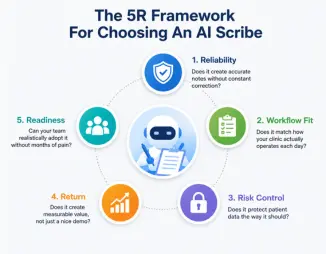
Most checklists out there just list features. I wanted something easier to remember.
So here is a simple framework I use when I look at any AI scribe. Call it the 5R Framework.
- Reliability. Does it create accurate notes without constant correction?
- Workflow Fit. Does it match how your clinic actually operates each day?
- Risk Control. Does it protect patient data the way it should?
- Return. Does it create measurable value, not just a nice demo?
- Readiness. Can your team realistically adopt it without months of pain?
If a tool fails even one of these five, that is worth pausing on. Not always a dealbreaker. But worth pausing on.
Key Factors To Check In An AI Medical Scribe
This is the core of the decision. Ten things worth your attention.
1. Medical Accuracy And Clinical Understanding
Not every transcription tool understands medicine. Some just hear words.
A good AI medical scribe should understand medical terms, specialty language, and clinical reasoning.
This is where Natural Language Processing and Large Language Models come into play.
My first comparison focused heavily on advertised accuracy percentages. That was a mistake.
Those numbers rarely show how well the AI handles a real, messy, specialty specific conversation.
A general accuracy score cannot replace actual clinical testing.
2. Specialty Specific Capabilities
A cardiology note does not look like a psychiatry note. They should not.
Different specialties bring different pain points, and the right tool should adjust for that.
- Primary Care. The problem is high patient volume. The need is fast, clean SOAP documentation.
- Mental Health. The problem is long, unstructured conversations. The need is strong context understanding.
- Dermatology. The problem is visual, exam based notes. The need is multimodal AI that can handle more than just speech.
- Emergency Medicine. The problem is speed under pressure. The need is fast, structured notes with zero delay.
If your clinic covers cardiology, dermatology, pediatrics, or behavioral health, ask for specialty specific samples before you buy anything.
3. EHR And Healthcare Software Integration
This factor decides whether your team actually uses the tool.
Ask if the scribe connects with Epic, Cerner, Athenahealth, or MEDITECH.
Ask about HL7 and FHIR APIs. Ask about interoperability with your current systems.
During workflow testing, I found something worth repeating here. Even a powerful AI model can fail adoption if clinicians must jump between separate systems.
The best tool fits quietly into what your team already does.
| Integration Type | Why It Matters |
| EHR | Less manual data entry |
| Telehealth | Supports remote visits |
| Practice management | Smoother daily workflow |
4. HIPAA-Compliant AI Scribe Requirements
This is a trust issue, not a checkbox.
Look for a HIPAA-compliant AI scribe with a signed Business Associate Agreement.
Ask about data encryption, access controls, audit logs, and SOC 2 certification.
Healthcare AI adoption depends heavily on how well patient data is protected. Skip this step and you risk far more than a bad note.
5. Real-Time Versus Later Scribing
Some tools write notes as the visit happens. Others generate them after.
| Real Time | Async |
| Notes appear right away | Notes come later |
| Fits fast paced clinics | Often cheaper |
| More active interaction | Fewer interruptions |
Neither option is wrong. It depends on your clinic pace.
6. Customization And Physician Control
An AI scribe should assist a doctor. It should never replace clinical judgment.
Look for custom templates, editing controls, voice commands, and flexible note styles.
If a tool locks you into one rigid format, that is a warning sign.
7. Data Ownership And Privacy
Ask direct questions before signing anything.
Who owns the clinical data once it is created? Can you export it freely? Is your data used for training the AI? How long is it stored?
Vague answers here should worry you.
8. Pricing Model And Total Cost
Pricing usually comes in a few shapes. Per provider subscription. Monthly plans. Enterprise licensing. Usage based pricing.
A simple way to think about AI scribe ROI for healthcare practices looks like this.
ROI equals time saved multiplied by provider value plus added patient capacity.
Cheap does not always mean affordable. Hidden costs show up later through corrections, poor integration, and retraining staff.
9. Vendor Support And Onboarding
Training matters more than most buyers expect at first.
Ask about onboarding length, ongoing customer support, and migration help if you are switching from another tool.
10. Future Roadmap
Technology in this space moves fast. Ask where the vendor is headed.
The same advances driving AI for content creation are also improving clinical documentation, allowing AI scribes to generate more structured and context-aware medical notes.
How To Compare Two AI Scribe Tools
If you are down to two or three finalists, put them side by side. A simple table beats a gut feeling every time.
| Area | Tool A | Tool B |
| Accuracy | ||
| EHR integration | ||
| Security | ||
| Pricing | ||
| Support |
Fill this in after your own trial, not from the sales deck. Vendor claims and real world performance are often two different things.
This small habit alone captures most of what people mean when they search for an AI scribe comparison guide.
How To Test An AI Scribe Before You Commit
Here is my evaluation process, the same one I would use myself. Do not skip steps, even the boring ones.
Step 1. Pick a small group of trial users across different roles.
Choose two or three physicians, not just one enthusiastic early adopter.
Mix specialties if you can. A primary care doctor and a specialist will notice very different problems with the same tool.
Step 2. Run three or four common patient scenarios through the tool.
Use real visit types your clinic sees every week, not a polished demo script.
Include at least one messy conversation. Interruptions. Accents. Side topics. That is where tools usually fail first.
Step 3. Time how long editing actually takes, not just note generation.
Note generation speed looks great on paper. It means very little if the doctor spends fifteen minutes fixing it after.
Track editing time by the clock, not by memory. People underestimate this badly.
Step 4. Collect honest feedback from the physicians who used it.
Ask specific questions, not just did you like it. Ask what felt slow, what felt wrong, what they would change.
Written feedback works better than a quick verbal comment in the hallway.
Step 5. Compare the real numbers against the ROI formula from earlier.
Plug your actual time saved and provider value into the formula.
If the number does not look meaningful after real testing, that tells you something a demo never will.
My AI Scribe Testing Checklist
Before you approve any AI scribe purchase, confirm each of these.
- Test at least 20 real conversations, not two or three
- Measure editing time honestly, note by note
- Check specialty specific accuracy, not general accuracy
- Review physician feedback in writing
- Verify security documents and the signed BAA
This is not complicated. It just takes a bit of patience most buyers skip.
Mistakes Doctors Make When Choosing An AI Scribe

These mistakes show up again and again. Watch for them.
Choosing based only on price
Low cost tools look attractive at first. Hidden costs appear later through manual corrections and weak integrations.
Ignoring EHR compatibility
A brilliant AI model means nothing if it cannot talk to your existing systems.
Skipping specialty accuracy testing
General demos do not reveal how a tool handles your specific field.
Ignoring security requirements
Patient trust is not something you get to rebuild easily.
Skipping staff training
Even the best tool fails if your team never learns to use it properly.
The cheapest option is rarely the lowest cost option once you count everything.
A Simple AI Scribe Comparison Framework
If you are comparing more than one vendor, score them using weighted criteria.
| Criteria | Weight |
| Accuracy | 25 % |
| Security | 20 % |
| Integration | 20 % |
| User experience | 15 % |
| Cost | 10 % |
| Support | 10 % |
This turns a fuzzy gut feeling into an actual AI scribe comparison guide you can defend to your leadership team.
A Real-World Example
Consider a five-physician primary care clinic. Before adopting an AI scribe, each doctor spent about 15 minutes on documentation per patient.
After adding a well-tested ambient AI tool, that dropped closer to 5 minutes of review per note.
That freed up almost two hours a day across the clinic. Two hours can mean more patients seen, or simply doctors going home on time for once.
What The Research Actually Shows
This is not just theory. A randomized clinical trial published in NEJM AI looked at 238 outpatient physicians across 14 specialties.
DAX Copilot was used in 33.5% of 24,696 visits, and Nabla was used in 29.5% of 23,653 visits during the study.
Nabla users saw a 9.5% drop in time spent per note compared to the control group.
DAX users did not show a significant change in documentation time versus the control group.
Both tools showed improvement in physician burnout scores, with Mini Z composite scores rising by 2.83 for DAX users and 2.69 for Nabla users.
Physicians reported clinically significant inaccuracies occasionally, with DAX scoring 2.7 and Nabla scoring 2.8 on a five point scale.
This tells us something important. Even strong AI scribes still need human review. No tool removes the doctor from the loop completely.
The market itself backs up why this decision matters so much right now. The U.S. AI in medical scribing market was valued near USD 397.05 million in 2024 and is projected to reach USD 2,955.72 million by 2033, growing at a CAGR of 25.09%.
Cloud based deployment already leads with a 78.51% share, and general documentation tools hold 48.19% of the market, while hospitals account for 54.44% of total usage.
What Comes Next For AI Scribes In Healthcare
The next wave includes ambient clinical intelligence, AI healthcare agents, automated coding, and predictive clinical decision support.
Multimodal documentation, where AI reads more than just speech, is also gaining ground.
Why This Matters For Buyers
Future capabilities matter more than they seem right now.
Switching AI healthcare systems later can be expensive, both in money and staff patience.
Buyers should pick vendors that keep improving, not ones that feel finished the day you sign the contract.
These shifts connect closely to broader AI healthcare solutions and healthcare automation efforts already underway across hospital systems.
Some of this overlaps with healthcare AI development work happening outside documentation too, including AI chatbot development for patient communication and medical software development built around clinical workflows.
Questions To Ask Before Choosing An AI Scribe Vendor
Bring this list to every vendor call.
- Is the tool HIPAA compliant with a signed BAA?
- Does it integrate with our specific EHR?
- How accurate are the notes for our specialty?
- Can physicians edit notes easily?
- How is pricing structured long term?
- Who legally owns the patient data?
My Evaluation Checklist
This is the shortlist I would personally run through before signing anything.
- Can clinicians actually trust the notes it produces?
- How much editing does a typical note need?
- Does it fit the workflow we already have?
- How is sensitive patient data handled?
- Is the vendor transparent when asked hard questions?
Final Thoughts
Choosing the right AI scribe is not about finding the tool with the loudest promises or the longest feature list. It is about finding something that quietly fits into the way your clinic already works.
I’ve seen how easy it is to get impressed by demos, only to discover later that small workflow problems become big frustrations. The best AI scribe is the one your team trusts, your doctors actually use, and your patients benefit from. When learning How to Choose the Right AI Scribe, focus on accuracy, security, integration, and real day to day value. Test carefully. Ask hard questions. The right choice should make healthcare simpler, not more complicated.
FAQ
What is the best AI scribe for doctors?
There is no single best option for everyone. The right fit depends on your specialty, EHR system, and budget. Test a few before deciding.
How accurate are AI medical scribes?
Accuracy varies by tool and specialty. Clinical trial data shows occasional inaccuracies even in leading tools, so human review still matters.
Are AI scribes HIPAA compliant?
Many are, but not all automatically. Always confirm a signed Business Associate Agreement before sharing any patient data.
How much does an AI scribe cost?
Pricing ranges from per provider subscriptions to enterprise licensing. Always calculate total cost, not just the sticker price.
Can AI scribes replace human medical scribes?
They can reduce the need for one in many settings, but most clinics still keep a human reviewing the final note.
What EHR systems work with AI scribes?
Most modern AI scribes support Epic, Cerner, Athenahealth, and MEDITECH, though integration depth varies by vendor.
Can AI scribes understand different accents and speaking styles?
Yes, modern AI scribes are improving at handling different accents, speech patterns, and medical conversations. However, performance can vary, so testing with your actual clinical environment is always a smart step.
How long does it take for doctors to adapt to an AI scribe?
Most clinicians need a short adjustment period to build trust and change their documentation habits. The smoother the workflow and onboarding process, the faster adoption usually happens.
Can an AI scribe help improve patient experience during visits?
Yes. By reducing typing and screen time, AI scribes allow doctors to stay more focused on conversations. Many providers find they can give patients more attention during appointments.
What happens if an AI scribe creates an incorrect medical note?
AI scribes should support doctors, not replace their judgment. Every generated note needs human review before approval because the physician remains responsible for accuracy and clinical decisions.

He is an AI & Technology Content Specialist covering generative AI, ChatGPT, AI tools, automation, and emerging technologies. His work focuses on researching complex AI developments and turning them into practical, easy-to-understand insights.