
Key Takeaways:
- Practical guidance, information, and writing are the top three ChatGPT use cases, together accounting for nearly 80% of usage.
- Personal use dominates work use, with around 70% of ChatGPT activity happening outside professional tasks.
- Writing is mostly about improving existing text, such as editing, rewriting, summarizing, translating, and changing tone not creating from scratch.
- Coding is a smaller use case than expected, making up only a few per cent of overall ChatGPT usage despite its strong association with AI.
- People increasingly use ChatGPT as a thinking partner for learning, planning, decisions, research, everyday tasks, and working through ideas.
You probably think most people use ChatGPT for coding. Or maybe just for writing essays. That’s the common guess, and honestly, it’s wrong.
A research paper looked at millions of real conversations and found something different. Coding? Small slice. Writing? Big, but not the biggest. So what’s really going on here?
In this article, we’ll answer how do people use ChatGPT with real numbers, real categories, and a few honest observations along the way. No guessing. Just what the data actually shows.
How Do People Use ChatGPT?
Here’s the short answer first, because you shouldn’t have to scroll forever to get it.
People mostly use ChatGPT for three things: practical guidance, seeking information, and writing. Together, these three cover almost 80% of everything people ask it to do. Coding barely makes a dent. Neither does “companionship”, despite what some headlines claim.
Work only makes up a small part of the picture too. About 70% of ChatGPT usage today is non-work. Personal stuff. Everyday life. Not spreadsheets and meetings.
Here’s a quick table to make it clearer:
| What people use ChatGPT for | What it actually looks like |
| Practical guidance | Advice, planning, everyday help |
| Seeking information | Asking questions, understanding topics |
| Writing | Drafting, editing, summarizing |
| Programming | Debugging, writing code (smaller share than you’d think) |
| Personal use | Reflection, exploring ideas, daily tasks |
Notice something? Writing shows up a lot. But it’s rarely “write this from scratch”. More often, it’s “fix this” or “make this sound better.” We’ll get to that.
What Are the Most Common Ways Do People Use ChatGPT?
Let’s slow down and look at the top three categories properly. This is where the actual answer to how do people use ChatGPT lives is.
1. Practical Guidance
This is the biggest bucket. People come to ChatGPT the way they’d come to a smart friend who happens to know a bit about everything.
Some real examples of what this looks like:
- “Help me plan a study schedule.”
- “How should I prepare for this interview?”
- “Create a weekly meal plan for two people.”
- “Explain this like I’m a total beginner.”
It’s not a search. It’s more like advice. People want something shaped around their own situation, not a generic list of ten tips.
2. Seeking Information
There’s a difference between looking something up and asking someone to explain it. ChatGPT sits closer to the second one.
People use it for definitions, comparisons, product research, and general “what does this mean” moments. In my own experience, this is where I noticed something small but important: ChatGPT gets more useful once you stop just asking for facts and start telling it what you plan to do with those facts. That one shift changes the quality of the answer a lot.
3. Writing
Writing deserves extra attention because it’s such a huge part of work usage specifically.
This covers:
- Drafting emails
- Rewriting rough paragraphs
- Editing tone
- Summarizing long documents
- Translating text
- Building outlines
Here’s the part most people miss. According to the research, about two-thirds of writing-related messages are about modifying text someone already wrote, not creating something brand new. So the “ChatGPT writes everything from scratch” idea? Mostly a myth.
Do People Use ChatGPT More for Work or Personal Tasks?
Now that you know what people do, the next question is where they do it.
| Usage type | Approximate share |
| Non-work (personal) | ~70% |
| Work | ~30% |
The research from NBER, the National Bureau of Economic Research, found that non-work usage has climbed above 70% of all activity, growing faster than work usage. OpenAI’s own summary of the data lines up with this too.
This matters because it reframes what ChatGPT actually is. It’s not just an office tool sitting next to your spreadsheets. For most people, it’s become something closer to a personal assistant. A note-taker. A thinking partner for regular life stuff, not just deadlines.
How Do People Use ChatGPT at Work?
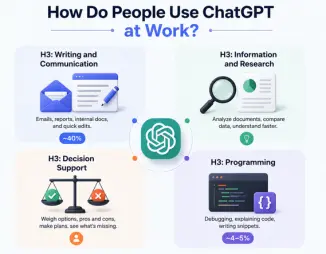
Work usage is smaller, but it’s still worth breaking down properly. Here’s what shows up most.
Writing and Communication
Emails. Reports. Internal docs. Quick edits before hitting send. This is, by far, the biggest chunk of work-related usage; writing tasks alone make up around 40% of work messages.
Information and Research
People use it to pull apart long documents, compare data points, or just understand something faster than reading the whole source themselves.
Decision Support
This one’s underrated. People ask ChatGPT to help them think through choices, weighing pros and cons, working out a plan, figuring out what they’re even missing.
Programming
Yes, developers use it. Debugging, explaining code, writing small snippets. But it’s a smaller slice of the whole pie than most people assume, closer to 4-5% of overall usage, not the dominant use case people imagine.
How Do People Use ChatGPT for Everyday Life?
This is where the research gets genuinely interesting, because non-work use is now the bigger half of the story.
- Learning – explaining concepts, practising for exams
- Planning – trips, schedules, budgets
- Personal organization – to-do lists, reminders, structuring your week
- Shopping research – comparing products before buying
- Travel – itineraries, local tips, packing lists
- Food and recipes – meal ideas, substitutions
- Personal reflection – working through thoughts, journaling-style conversations.
What Do People Actually Ask ChatGPT to Do?
Sometimes it helps to just see the requests themselves.
| Goal | Example request |
| Learn | “Explain photosynthesis simply.” |
| Write | “Rewrite this email professionally.” |
| Plan | “Create a 7-day study plan.” |
| Decide | “Compare these two laptops.” |
| Research | “Summarize this research paper.” |
| Brainstorm | “Give me 20 content ideas.” |
| Solve | “Help me understand this error message.” |
Simple stuff, mostly. Not magic. Just useful, everyday requests.
Asking vs Doing vs Expressing: How People Interact With ChatGPT
Here’s where the research gets a bit more technical, but stick with me this part is worth understanding.
Researchers grouped every message into three types:
| Interaction type | Approximate share | What it means |
| Asking | 49% | Questions, advice, information-seeking |
| Doing | 40% | Completing a task, producing something |
| Expressing | 11% | Reflection, venting, roleplay |
OpenAI’s official summary confirms this same breakdown.
I’ll be honest, this one changed how I personally think about the tool. I used to assume ChatGPT was mostly a “make this for me” machine. Turns out, almost half of all usage is just people thinking out loud with it. Asking, not producing. That’s a different kind of value than I expected.
Is ChatGPT Mainly Used for Coding?
No. Not even close.
Coding matters, sure. But it’s a small fraction of overall usage, a few per cent, not the dominant use case people assume when they picture “AI tools”.
The bigger three: practical guidance, information, and writing, dwarf it by a wide margin. If your mental image of ChatGPT users is a room full of developers, the data says otherwise. Most people asking ChatGPT things today aren’t touching a single line of code.
How Do People Use ChatGPT for Learning?
Students turn out to be one of the heaviest user groups, and it makes sense why.
Difficult topics get broken down into plain language. Practice questions get generated on demand. Revision plans get built around whatever the student is actually struggling with not a generic syllabus. If you want a deeper look at exact prompts students use for this, our guide on ChatGPT prompts for students walks through real examples.
Teachers use it too, in a slightly different way. Lesson activities, simplified explanations, and quick classroom materials. Though this matters, anything generated should still get reviewed before it reaches a classroom. Our ChatGPT prompts for teachers guide covers this in more practical detail.
How Do People Use ChatGPT for Different Professions?
Rather than write a giant list, here’s a table that captures the pattern.
| Profession | Common use |
| Students | Learning, explanations, revision |
| Teachers | Lesson planning, materials |
| Marketers | Research, ideation, copywriting |
| Developers | Debugging, code assistance |
| Managers | Analysis, communication, planning |
| Job seekers | Resume help, interview prep |
| Writers | Drafting, editing, research |
Marketers, for example, tend to use ChatGPT for campaign ideas, quick audience research, and content briefs. This works a lot better when it’s paired with a structured approach, like the ones in our ChatGPT prompts for marketing guide.
Job seekers lean on it differently: mock interview questions, feedback on answers, and spotting weak spots before the real thing. Our ChatGPT prompts for the interview preparation page have specific examples for this.
How I Personally Use ChatGPT
I want to be upfront here: this part is just my own perspective, not a research finding. Take it as one person’s take, not a study result.
When I first started using it, I treated it like Google. One question, expecting one perfect answer back. That didn’t really work. The answers were fine, technically correct even, but too generic to actually use.
What changed things for me:
- I started giving it real context, not just “write an intro”, but who it’s for and why.
- I began asking follow-up questions instead of accepting the first draft.
- I asked it to critique its own output, which sounds odd but genuinely helps.
- I verify anything that sounds like a fact before I trust it.
- I stopped treating each prompt as one-off. Conversations work better as a workflow, not a single ask.
Small shifts. But they made a noticeable difference in how useful the tool actually felt.
Common Mistakes People Make When Using ChatGPT
A few patterns show up again and again, based on both the research and what people generally report.
- Treating it like Google: Expecting a single perfect answer instead of a conversation.
- Giving too little context: Vague prompts get vague answers.
- Asking overly broad questions: “Help me with marketing” isn’t specific enough to be useful.
- Accepting the first response: The second or third draft is usually better.
- Not verifying facts: Especially for anything that matters, like numbers or dates.
- Cramming one giant prompt: Complex tasks work better broken into steps.
For a much deeper breakdown of these, our page on common ChatGPT mistakes goes through each one with fixes.
How to Get Better Results From ChatGPT
This isn’t a beginner tutorial; we’ve covered that elsewhere. This is more about what separates people who get genuinely useful answers from people who don’t.
The pattern usually comes down to a few things: giving context up front, being specific about the outcome you want, adding constraints where they matter, and treating the first answer as a draft rather than a final one. OpenAI’s own prompting guidance points in this same direction clear, specific prompts with enough context, refined through follow-up. (OpenAI Help Centre)
If you’re just exploring what the tool can even do before signing up for anything, you can also check out ways to use ChatGPT without logging in first.
How ChatGPT Usage Is Changing
Non-work use grew faster than work use. More countries adopted it, especially lower-income regions, where growth actually outpaced wealthier ones. The user base itself changed too; early on it skewed heavily male, and that gap has closed dramatically since.
This part of the article will likely need updates over time, since usage patterns keep shifting. OpenAI has started publishing ongoing usage data through what they call Signals, which should help keep numbers like these current going forward.
What Does the Research Actually Tell Us?
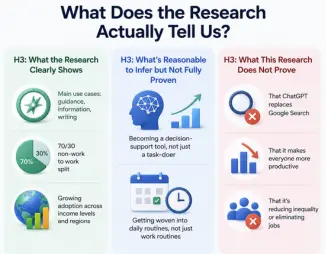
It’s worth being honest about what the data supports and what it doesn’t.
What the research clearly shows:
- The main use cases: guidance, information, writing
- The 70/30 non-work-to-work split
- Growing adoption across income levels and regions
What’s reasonable to infer but not fully proven:
- ChatGPT is becoming a decision-support tool, not just a task-doer
- It’s getting woven into daily routines, not just work routines
What this research does not prove:
- That ChatGPT replaces Google Search
- That it makes everyone more productive
- That it’s reducing inequality or eliminating jobs
Numbers are numbers. What they mean beyond that takes some judgment, and it’s easy to overreach.
Limitations of the Research
No study is perfect, and this one has some clear boundaries worth mentioning.
It only covers consumer accounts; enterprise and business-plan usage isn’t included, and that could look pretty different. Messages were classified using automated systems, not manually checked one by one. Gender wasn’t directly known either; it was estimated from names, which is a rough proxy at best. And this is descriptive data; it shows what people do, not proof of why it works or whether it actually boosts productivity. The paper itself is labelled a working paper, and it discloses author affiliations with OpenAI, which is worth knowing when reading the conclusions.
What This Means for Everyday ChatGPT Users
If there’s one takeaway from all this, it’s that the biggest value probably isn’t “do this task for me”. A huge chunk of usage is people asking questions, working through decisions, and thinking something out loud.
So maybe use it to:
- Understand something faster
- Think through a decision
- Create something you can then improve
That’s a decent framework to keep in mind next time you open a chat.
Conclusion
People use ChatGPT for a lot more than coding; that assumption just doesn’t hold up.
The biggest categories are practical guidance, information seeking, and writing, and most of that usage now happens outside of work.
From what I’ve seen personally, the real improvement comes from treating it as a thinking partner, not a one-shot answer machine.
Worth exploring our other guides if you want to go deeper into specific use cases.
FAQs
What do people use ChatGPT for most?
Mostly practical guidance, seeking information, and writing these three together make up nearly 80% of all usage.
Is ChatGPT used more for work or personal use?
Personal use. Around 70% of usage is non-work-related, and that share keeps growing.
What is the most common use of ChatGPT?
Practical guidance asking for advice or help shaped around a specific personal situation.
Do most people use ChatGPT for coding?
No. Programming makes up a small share of total usage, despite the common assumption.
How do people use ChatGPT at work?
Mostly for writing emails, reports, and documents, followed by research, decision support, and some programming.
Is ChatGPT replacing Google Search?
Not exactly. The research doesn’t show this directly. The two tools tend to get used for different kinds of questions.

He is an AI & Technology Content Specialist covering generative AI, ChatGPT, AI tools, automation, and emerging technologies. His work focuses on researching complex AI developments and turning them into practical, easy-to-understand insights.